For 1 in 8 children, the deepest harm comes from someone they trusted. Healing is possible – but only through care that stays.
There is a number we can no longer keep quiet about: 1 in 8.
According to the most comprehensive global study ever conducted on the subject, roughly 1 in 8 children will experience sexual abuse before they reach adulthood. Not in some distant place. In every kind of community, in every country where children are found – including the six where Kids Alive International serves.
And in most cases, the person who causes the harm is not a stranger. It is someone the child was taught to trust – a relative, a neighbor, an authority figure. That betrayal is part of the wound. It teaches a child that safety is fragile, and that the people closest to them can cause the deepest pain.
That truth is too important to leave in the dark. It is why we are raising our voice, and asking you to raise yours, through the 1 in 8 campaign.
Why we're speaking up
For generations, abuse has survived on silence. Shame keeps children quiet. Stigma keeps families quiet. And in far too many places, the justice system stays quiet too.
Fewer than 3% of abusers are ever convicted – and in the six countries we serve – Guatemala, Haiti, Kenya, Lebanon, Peru, and Zambia – accountability is rarer still. In Peru, of more than 25,000 reported cases of sexual violence against minors between 2017 and 2022, courts issued only 155 sentences. In Guatemala, investigators have documented an impunity rate of 99% in cases of violence against women. Across Africa, researchers describe a culture of impunity in which very few cases reach court and even fewer end in conviction.
When accountability is this rare, awareness is not a nice-to-have. It is a form of protection. Advocacy is how we refuse to let these children remain unseen.
What the numbers mean for a child
The harm of abuse does not end when the abuse does.
Decades of research known as the Adverse Childhood Experiences study have shown that children who carry this kind of trauma are far more likely to struggle for the rest of their lives. They are 12 times more likely to attempt suicide and 8 times more likely to fall into addiction.
These numbers describe children who face compounding hardship – and the children we serve rarely face only one. Alongside abuse, many carry poverty, loss, displacement, and instability. That does not make their future hopeless. It makes the care they receive matter even more.
But this is not where their story ends
Here is what the same body of research makes clear: healing is real.
When a child is surrounded by safety, given room to process their pain through therapy, and supported by someone willing to pursue justice on their behalf, the trajectory changes. Fear gives way to security. Silence gives way to voice. Trauma gives way to triumph.
But that transformation does not happen in a single moment. It is not a rescue. It is a relationship.
The only way through is to stay
This is why Kids Alive does not offer only one kind of help. Healing a wound this deep takes a whole continuum of consistent, loving care – and it takes time.
For some children, that means keeping their family together so they never lose the home they know. For others, it means a Safe Haven or a family-style home where they can finally feel secure. It means trauma-informed counseling, education, spiritual care, and advocates who walk beside them through a long fight for justice. Every one of these programs says the same thing to a child who was taught that people leave: we are not going anywhere.
That is what Stay means. A child who has been betrayed does not heal because someone showed up once. They heal because someone kept showing up.
Show up at $8, and stay
There is a quiet symmetry in this campaign: 1 in 8 children experience abuse, and for $8 a month, you can be one of the people who stays.
Eight dollars is not a dramatic, one-time rescue. It is something better – a steady, faithful presence that funds the slow, real work of healing, month after month, for as long as it takes. It is the difference between a child who is helped once and a child who is never alone again.
We are not asking for a moment. We are asking you to stay.
Join us at kidsalive.org/8. Give $8 a month, and stay with a child for the whole journey from trauma to triumph.
Because 1 in 8 children need many things. But more than anything, they need someone who will stay.
A note on the numbers: Estimates of child sexual abuse vary – you'll see 1 in 5, 1 in 8, 1 in 11, and others – because definitions differ and, tragically, so many children are too afraid to ever report. We use a conservative global estimate, knowing the true scope is almost certainly worse. But the exact ratio isn't the point. Whether it's 1 in 4 or 1 in 11, it is too many. Join us in bringing that number down.
The data behind this
1 in 8 children experience sexual abuse — Stoltenborgh et al., A Global Perspective on Child Sexual Abuse: Meta-Analysis of Prevalence Around the World, Child Maltreatment (2011) https://journals.sagepub.com/doi/10.1177/1077559511403920
12 times more likely to attempt suicide, 8 times more likely to face addiction — Felitti et al., The Adverse Childhood Experiences (ACE) Study, American Journal of Preventive Medicine (1998) https://pubmed.ncbi.nlm.nih.gov/9635069/
Many of us who care deeply about vulnerable children begin with the same desire: we want to help. Whether we are parents, teachers, mentors, foster families, or members of a church community, our hearts are moved by the needs of children who have experienced hardship. Yet many caregivers discover that good intentions alone do not always tell us how to respond when a child’s behavior becomes confusing or difficult. A child may react with sudden anger during a small moment of correction, withdraw even when kindness is offered, or seem constantly watchful, as if expecting something to go wrong. For adults who genuinely want to love and support them, these reactions can be puzzling—and sometimes discouraging.
Often, what we are witnessing is not simply behavior—it is the lingering effect of experiences that shaped how a child’s developing mind learned to survive.
In the world of child development, these experiences are often described as Adverse Childhood Experiences, or ACEs. ACEs include situations such as abuse, neglect, exposure to violence, instability within the home, the loss of a caregiver, or growing up in environments where fear and uncertainty were common. These events occur while a child’s brain is still forming the pathways that guide emotional regulation, trust, and relationships.
When we begin to understand this, many of the behaviors we see in children begin to look different. Instead of viewing them only as discipline problems or personality traits, we begin to recognize them as survival responses learned in environments that once felt unsafe.
This understanding is the foundation of what is known as trauma-informed care. Trauma-informed care is an approach to caring for children that recognizes how past trauma shapes behavior, emotions, and relationships, and responds in ways that prioritize safety, trust, and healing. Rather than asking, “What is wrong with this child?” trauma-informed care invites us to ask a different question: “What might this child have experienced?”
When Survival Shapes the Brain
A child’s brain is wonderfully designed by God to adapt to its environment. In safe and nurturing settings, those adaptations support curiosity, learning, creativity, and healthy relationships. However, when a child repeatedly encounters fear, instability, or harm, the brain begins adapting in order to protect itself.
Instead of prioritizing connection and exploration, the brain learns to prioritize survival.
This can leave a child’s nervous system constantly on alert. Situations that appear ordinary to us—such as a raised voice, a change in routine, or a moment of correction—may feel overwhelming to a child whose mind has been trained to expect danger. Some children respond by becoming defensive or aggressive. Others withdraw emotionally or struggle to engage with the people around them. Some find it difficult to concentrate or regulate their emotions.
When we begin to see these reactions through the lens of trauma, we recognize something important: many of these behaviors are not signs of rebellion or defiance. They are signs of a child who has been trying to stay safe on their own.
Trauma-informed care invites us to respond to these moments with curiosity rather than frustration. Instead of seeing behavior as something to simply correct, we begin to recognize it as communication — a signal that a child may be overwhelmed, frightened, or unsure how to express what they are feeling. When caregivers respond with patience, stability, and compassion, children slowly begin to experience something many of them have rarely known before: safety in relationship.
Compassion and Our Calling as Christians
For followers of Christ, learning to see children through this lens is more than a helpful framework—it is part of our calling. Jesus reminds us in Matthew 22:37–39 that the greatest commandment is to love the Lord our God with all our heart, soul, and mind. That kind of love shapes how we see and respond to the people around us, especially those who carry wounds others may not fully understand.
Walking alongside children who have experienced trauma often requires exactly this kind of love. It calls for patience when progress feels slow, humility when we do not have all the answers, and perseverance when the journey becomes difficult. Yet this is the same posture Christ modeled—moving toward those who were hurting and restoring dignity in a world where the ripple effects of sin have caused harm.
Today, we are grateful that research has given us deeper insight into how healing unfolds. Trauma-informed care offers wisdom that helps caregivers respond to children with greater understanding and compassion. What is remarkable is how closely these insights reflect the way God designed us as human beings—reminding us that when we walk patiently alongside children, we participate in the work of restoration He desires for them.
Practicing Trauma-Informed Care
When we begin to understand trauma, the natural next question is: How do we respond differently?
Trauma-informed care does not begin with complicated techniques. It begins with a shift in how we see children and how we show up for them.
Instead of focusing only on correcting behavior, trauma-informed care invites caregivers to focus on relationship, safety, and connection. Children who have experienced hardship often need steady adults who help them feel secure enough to learn, trust, and grow again.
At the heart of trauma-responsive care is the understanding that every child carries three fundamental needs:to connect, to be seen, and to be heard. When caregivers intentionally create space for these needs to be met, children begin to experience belonging and safety again.
In practice, this often looks like several simple but powerful shifts in how we care for children:
Presence and regulation. A calm, steady adult can help settle a child whose emotions feel overwhelming. Sitting with a child, listening without rushing them, or simply remaining steady during difficult moments can help their nervous system begin to regulate.
Restoring dignity and agency. Trauma often leaves children feeling powerless. Offering choices, inviting their voice, and involving them in decisions that affect them helps rebuild confidence and trust.
Rebuilding identity through truth. Trauma can distort a child’s sense of identity, whispering lies that they are unwanted or unworthy. Caregivers and faith communities have the opportunity to speak a different message — reminding children that they are chosen, valued, and deeply loved by God.
When these practices are lived out consistently, children slowly begin to experience the stability that allows healing to take root.
From Trauma Toward Healing
At Kids Alive International, these principles shape the way we walk alongside children around the world. Across the communities where we serve, our teams provide holistic care through restorative education, counseling, family support, and Christ-centered discipleship.
Our goal is not only to address the wounds children have experienced, but to help them rediscover their identity and their future. While trauma may attempt to define a child by what has happened to them, the message of the Gospel tells a different story: every child is created by God, deeply loved, and invited into a flourishing life made alive in Christ.
This is the journey we witness every day across Kids Alive: children moving from trauma to triumph.
A Resource for Caregivers
For many caregivers, learning about trauma-informed care is the first step toward responding to children with greater wisdom and compassion. As we begin to understand how past experiences shape a child’s behavior, we can move from reacting to behavior toward meeting the deeper needs underneath it—helping children feel safe, seen, and heard.
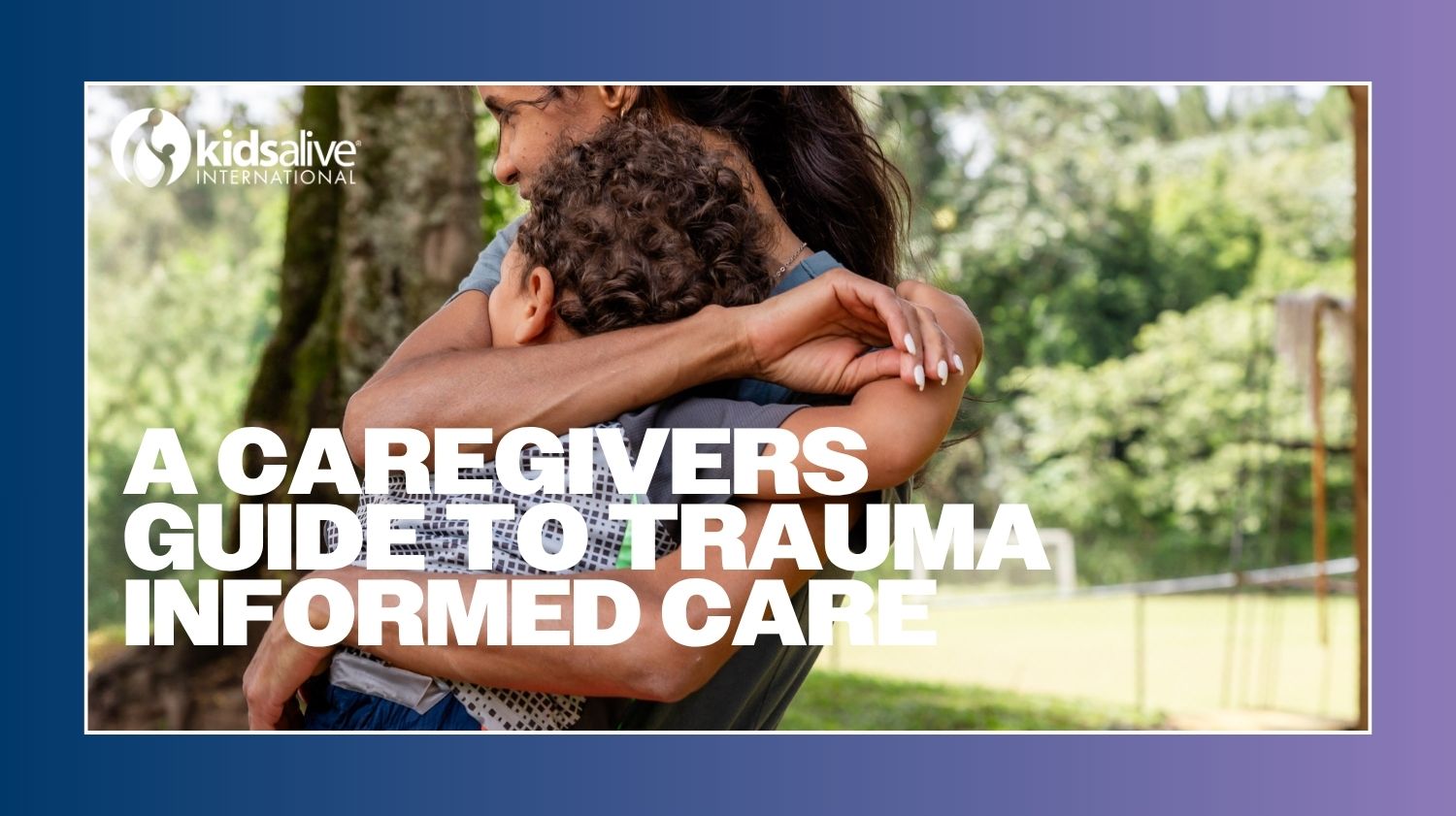
To support caregivers in this journey, Kids Alive International created a free resource called “A Caregiver’s Guide to Trauma-Responsive Care.” This guide introduces practical principles that help adults understand how trauma affects children and how consistent relationships, compassionate presence, and truth about identity can support healing.
If you are walking alongside a child who carries difficult experiences, this resource offers practical guidance and encouragement for the road ahead.


.webp)